A Map of the Goldbach Problem
By Christopher Yamba, developed with AI research assistance.
A mathematical problem can be perfectly easy to state and extraordinarily difficult to see. Every even integer greater than two, Goldbach proposed, is the sum of two primes. Thirty is 7 + 23, or 11 + 19, or 13 + 17. The assertion is that the same kind of representation exists for every even number, without exception.
The strong Goldbach conjecture remains open. This project is not a claimed solution. It is a research program built around a different question: what happens when we place several mathematical views of the same problem side by side, follow their connections, and ask exactly where each one stops?
Explore the interactive Goldbach research graph. You can also read the illustrated article (PDF) or inspect its LaTeX source.
The shape of a prime sum
Imagine listing the odd primes along the rows and columns of a grid. Place a box wherever the row prime and column prime add to at most a chosen even number N. The boxes form a staircase, a Ferrers diagram. Increase N by two, and the new boxes represent exactly the prime pairs summing to the new target.
For 30, the new boxes record 7 + 23, 11 + 19 and 13 + 17, together with the reflected orderings. The layer is symmetric: exchanging the two primes reflects a box across the diagonal. It also has at most one box in each row and column.
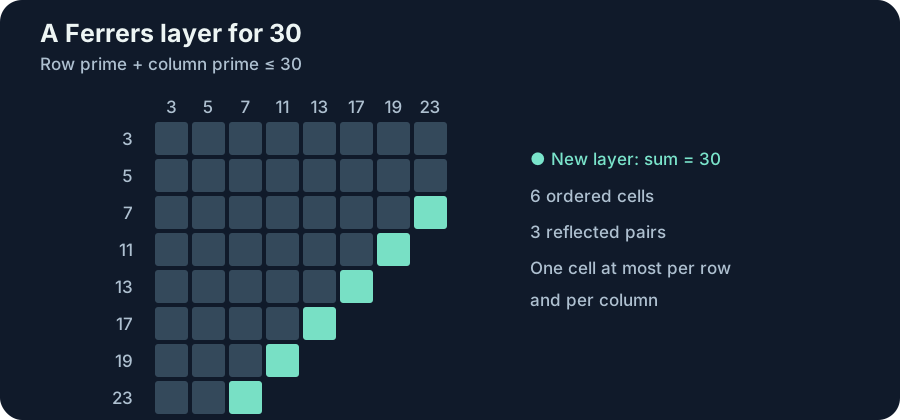
The highlighted boundary contains the three representations of 30 and their reflections.
Goldbach becomes the assertion that every even layer contains at least one box. The picture does not prove this. Its value is that it makes a question visible: can the arithmetic of the primes force something about these particular boundaries that is not true of an arbitrary staircase?
The same construction extends to three or more dimensions. An ordered tuple of primes becomes a point in a higher-dimensional region, and representations appear on its outer shell. The ternary Goldbach theorem tells us that certain three-prime shells are populated. But binary Goldbach asks for a point in a specific slice of such a shell. A populated object need not populate every slice. The visual difference is a useful guide to the missing argument.
The reflection and the sieve
A second view starts with the reflection a ↦ N − a. Mark a position only when both a and its reflection are prime. The marked positions come in reflected pairs, except for a possible fixed point at N/2. In matrix language, these pairs form small blocks, and their count is a trace.
A third view removes candidates by divisibility. For each small prime, cover any candidate where it divides one summand, taking care not to discard the prime itself. The candidates that survive a complete sieve are the prime representations. Goldbach asks whether the divisibility classes can ever cover the whole relevant interval.
These perspectives connect combinatorics, matrices and graph theory to classical number theory. They also expose a difficulty. The Chinese remainder theorem describes admissible residues over a complete period. Near the square-root sieve level, that period is enormously larger than the interval for a single Goldbach target. A positive density across the full period is not, by itself, a survivor in the short interval we need.
A warning from the experiments
During the exploratory work, we studied prime-pair and semiprime-pair counts after removing small prime factors. In a finite sample at one cutoff, the prime-pair count never fell below the semiprime-pair count. Yet an average calculation indicates that this comparison must reverse infinitely often at sufficiently large targets for a range of shallower cutoffs.
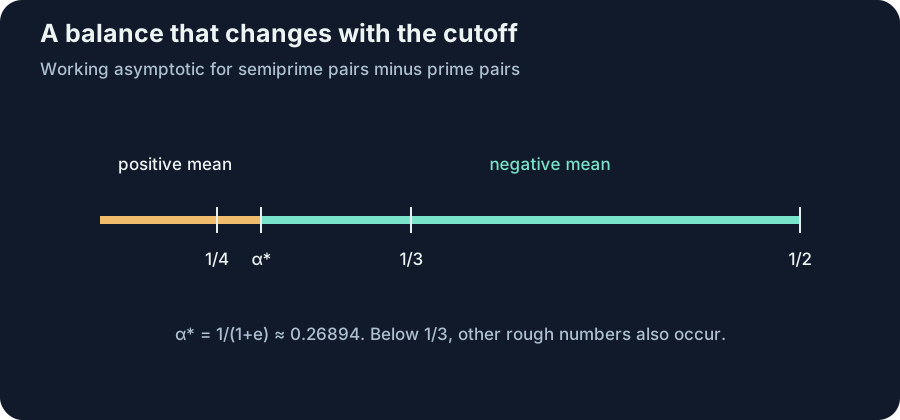
The proposed mean balance changes sign at the marked threshold. Below one third, the two named pair classes do not include every rough survivor.
That is a striking reminder: patterns can persist through many computations and still fail eventually. The calculations and derived asymptotic are research results requiring independent mathematical review, not a proof of Goldbach and not an established priority claim. The interactive map labels such work separately from classical results and open proof targets.
A path through parity
One of the strongest existing landmarks is Chen’s theorem: every sufficiently large even number is a prime plus a number with at most two prime factors. The remaining problem is to guarantee that one of those complements is itself prime.
This is a parity question about prime factors. The Liouville function assigns a sign according to whether the number of prime factors, counted with multiplicity, is even or odd. Under a cube-root roughness condition, a survivor can only be prime or semiprime. The difference between the two kinds of prime-pair candidates can then be expressed as a signed sum. If the right sign could be proved for each even target, it would yield a prime pair.
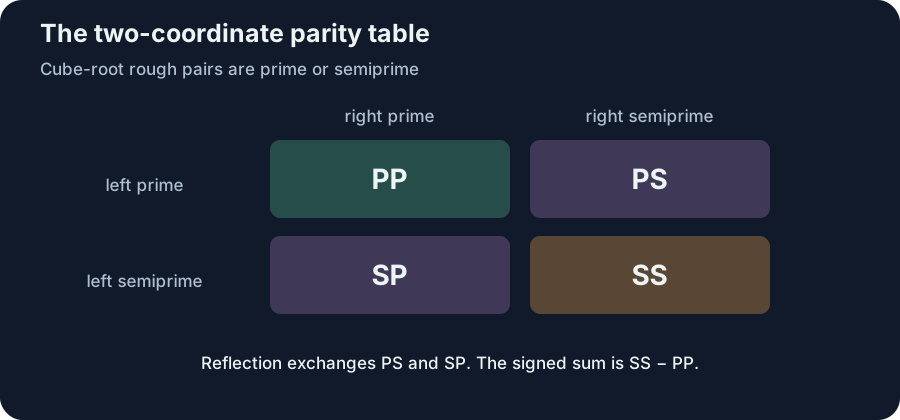
The mixed pair types exchange under reflection, so their signed contributions cancel.
The words for each target carry almost all the weight. The research program develops average estimates and experiments around that signed expression, but a negative average leaves room for individual exceptions. Likewise, broad distribution of primes is not enough by itself: a set can contain almost all primes and still be arranged to miss infinitely many even sums.
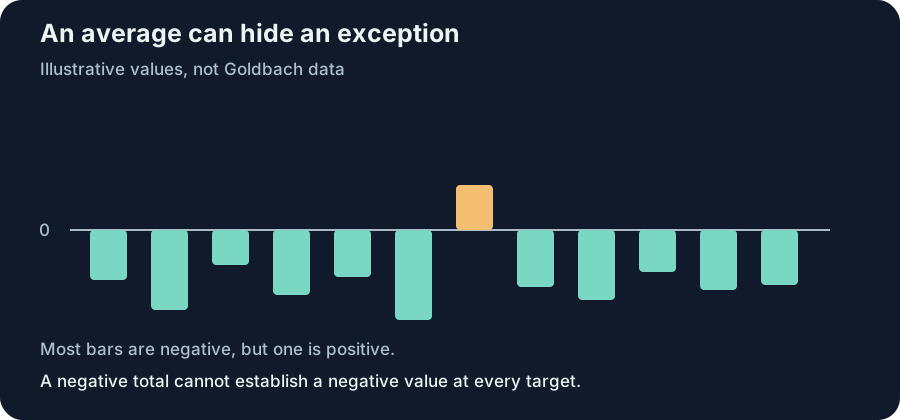
These are illustrative values, not Goldbach data. A negative average does not settle each individual case.
An especially concrete existing conditional path comes from Huang and Li. Their work relates eventual Goldbach to a particular Möbius-weighted distribution hypothesis in arithmetic progressions. The hypothesis is unproved. A later preprint identifies a moving-endpoint issue in the published argument and claims a repair under the original assumptions; that claim has not been verified here. This route provides a precise place to ask whether graph, sieve or multiplicative-function methods can contribute.
Research as a navigable structure
The research graph brings these ideas together: Ferrers layers, higher-dimensional shells, reflections, prime-sum graphs, sieve wheels, parity, Fourier analysis, and verification. Select an idea to read what it means, what it connects to, and what remains to be proved. Search retrieves descriptions from the curated graph; it does not generate mathematical answers.
The writing and research were assisted by OpenAI Codex and research agents. The exact model identifier and reasoning effort used for the original drafting were not retained in the available publication record.
The program was developed through a combination of literature study, computation and coordinated AI-assisted research, including separate criticism of candidate arguments. A small Lean 4 file kernel-checks elementary reflection, trial-division primality, a finite case for 30, and a modular no-shared-summand implication using a self-contained prime predicate; it does not verify the analytic claims or the Goldbach conjecture. Numerical evidence, conditional results and conjectural directions are kept distinct. The deductions developed during this investigation remain subject to expert review and a fuller prior-art search.
I am also developing another complementary approach to the problem, which I intend to present in a forthcoming follow-up publication. The purpose of this first program is to make the present landscape visible and provide an honest foundation for the next step.
Further reading
- Helfgott, The ternary Goldbach conjecture is true.
- Huang and Li, On the connection between the Goldbach conjecture and the Elliott–Halberstam conjecture.
- Friedlander and Iwaniec, Asymptotic sieve for primes.
- Arneth, A Cubic Prime Minorant and the Remaining Correlation in Binary Goldbach, an unverified preprint on a related research direction.
- OpenAI mathematics repository.