Split a collision by remembering the lost choice
We reviewed why Argon's finite apex assignments and passing checks did not establish the universal Phase 2 bijection. Christopher then proposed studying the collision fibers directly and using extra dimensions to separate their inputs.
A counting identity is not an object-by-object translator
The KR1 counting identity has reported proofs, including Mizuno's Theorem 1.1. Our goal is an explicit reversible construction between the original partition families. The unresolved step in our chosen factorization is the middle bridge:
B ↔ U ↔ C ↔ A · U ↔ C remains incomplete
Here U is the weighted-column model and C consists of sectors (a,b,μ,ν), with weight a² + 3ab + 3b² + Σμ + 3Σν. A finite matching table or arithmetic weight identity does not supply the full forward and inverse algorithms.
A solved restricted family, drawn concretely
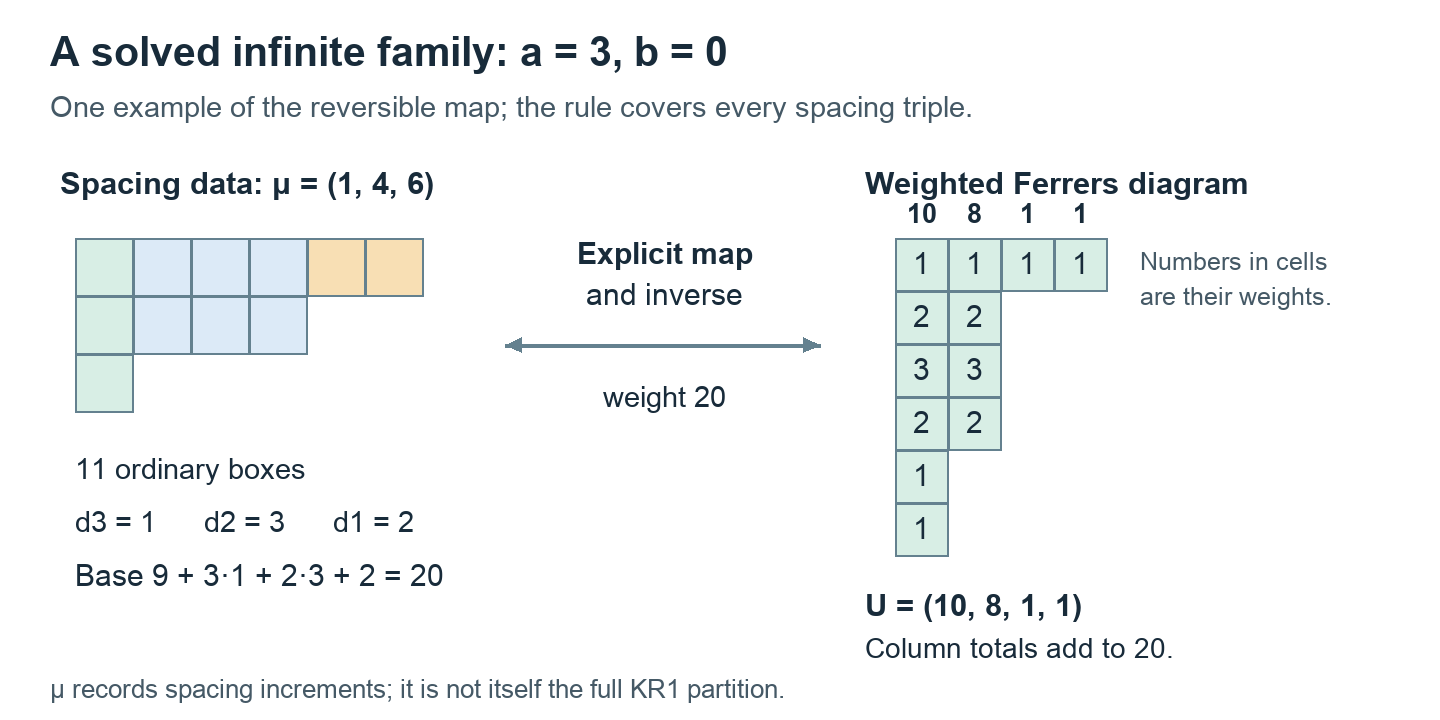
This is a restricted infinite result, not a full KR1 bijection. Its significance and novelty have not been established by comparison with the closest literature.
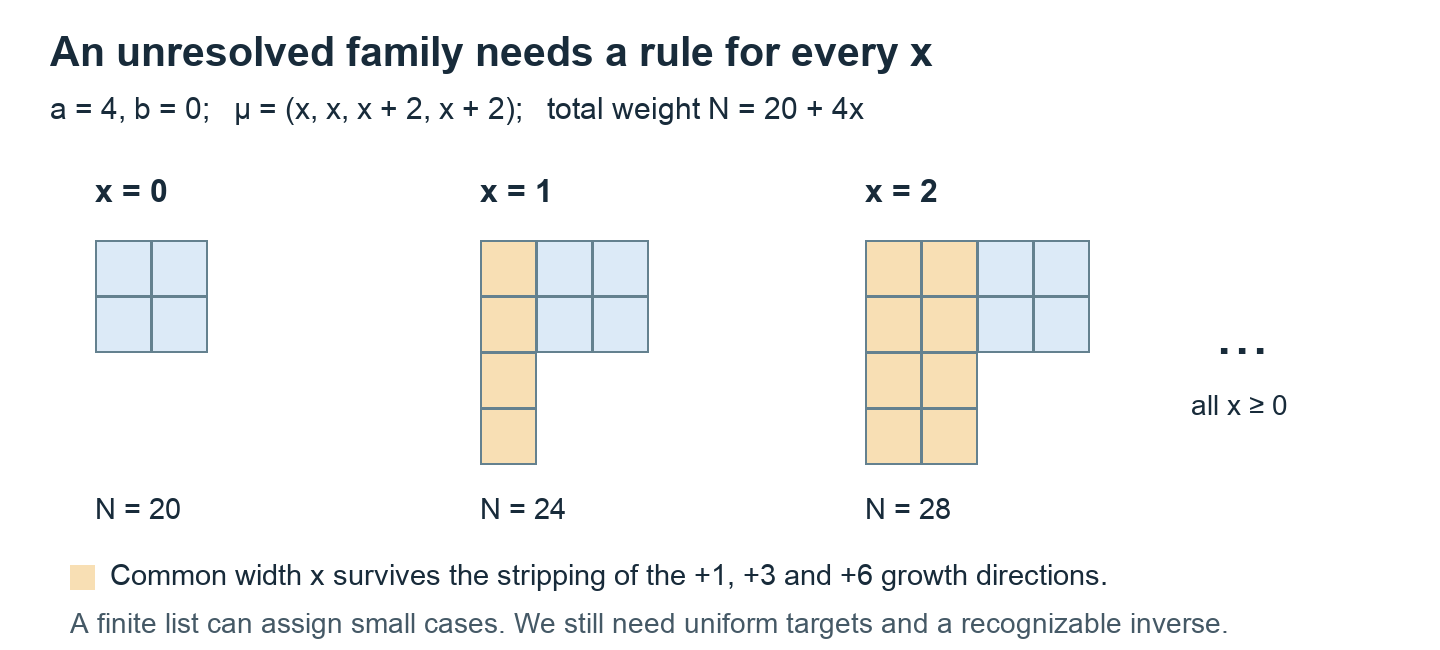
Why a family needs more than a finite list
Historical figure: this y=2 band was open at the initial review. It was subsequently covered by the partial constructions below; the title in the original image describes that earlier checkpoint.
Replace one ambiguous image with distinguishable arrangements
“What if we consider the U as an ambiguous image that needs to be split into two distinct images U1 and U2.”
Christopher proposed starting with T1 and T2 that collapse to the same U, arranging the actual numbered squares differently in additional dimensions, and generalizing to every finite fiber size. Ten colliding inputs could use ten extra directions. Existence of one suitable procedure comes before optimizing dimension.
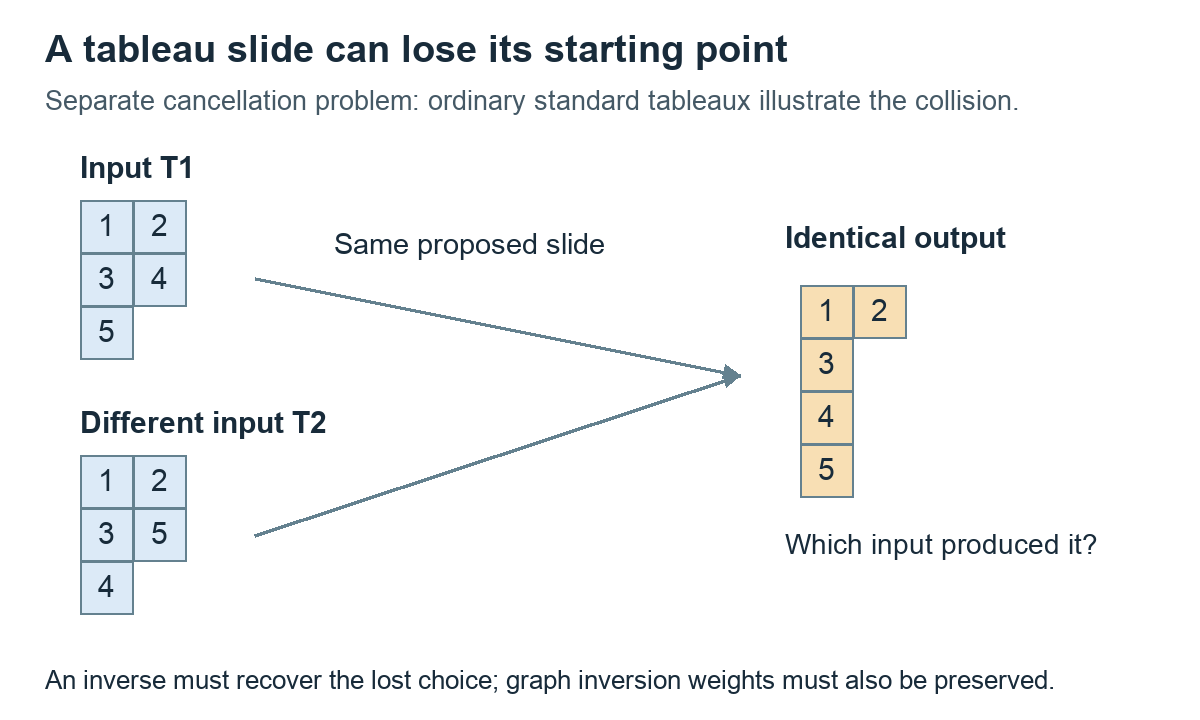
The guiding question was: what would the extra direction remember (a cut location, overlap, ordering or carry), and how would the final object let us undo it?
First constructions motivated by that idea
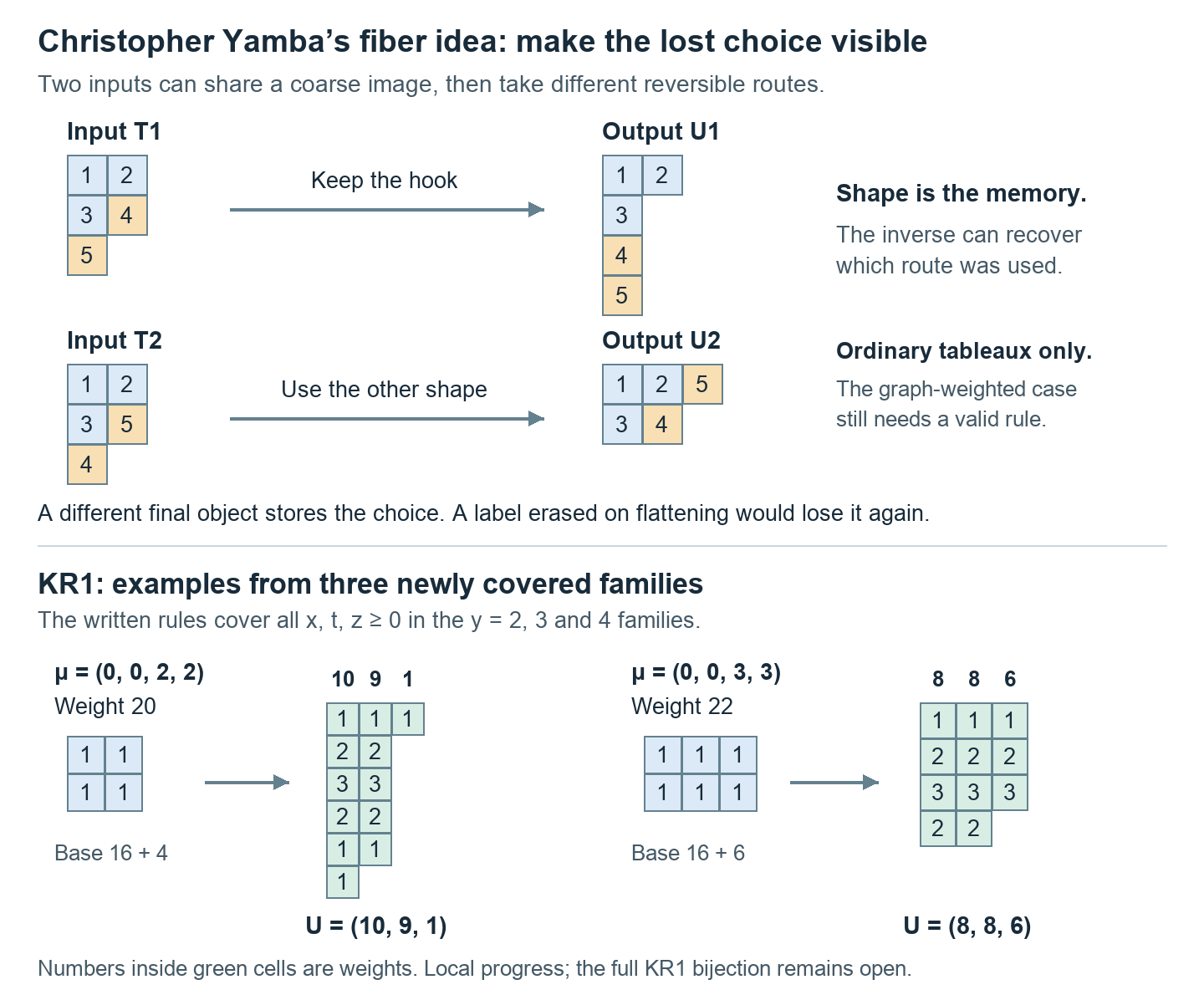
These were related shape-routing and column-encoding explorations. They did not implement Christopher's complete algorithm of introducing a fresh axis for each placement.
Try literal placements; record the inverse and first failure
The independent Claude Code handoff asked for reversible permutations of occupied and empty positions in a discrete multidimensional space, a placement ledger, and patterns that might generalize. Worktrees were kept separate. Its output then informed the joint core attempt summarized in iteration 02.
Still open: a general selected family of higher-dimensional arrangements and an intrinsic, weight-preserving correspondence with the original targets.