A fresh dimension for each assignment
Christopher questioned whether talk of “height” had narrowed his idea to 3D. His proposal permits another dimension at every square-placement step, with an exact inverse and no fixed global dimension cap.
What genuine KR1 diagrams look like
Christopher asked to see actual residue and gap partitions, and whether a rearrangement could stay in 2D. These are unfilled Young/Ferrers diagrams: row lengths are parts and each square contributes one unit. Staying in 2D is allowed; validity, weight, inverse and complete coverage are the obligations.
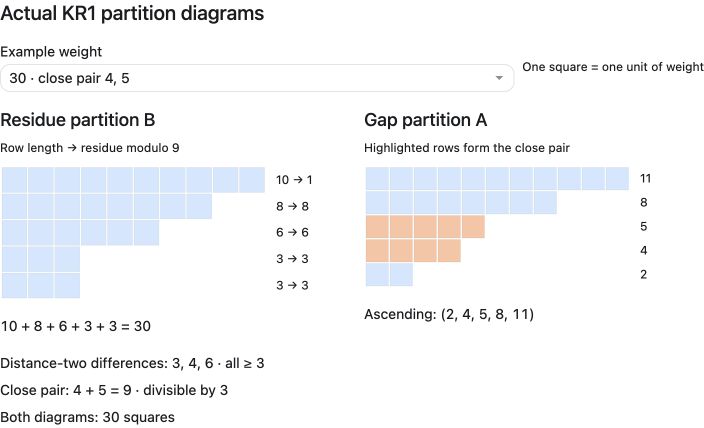
Explore the weight-30 and weight-21 examples
The gap rules concern ascending positive parts: parts two positions apart differ by at least 3; adjacent parts differing by at most 1 must sum to a multiple of 3. No cell labels or graph-inversion statistic are part of this original KR1 definition.
Cancellation is a separate signed-tableau problem
A determinant expansion introduces plus and minus occurrences. Each contributes a signed term ±qinv_G(T). An opposite-sign pair with the same graph-inversion count contributes zero. This removes algebraic contributions, not squares from a KR1 partition.
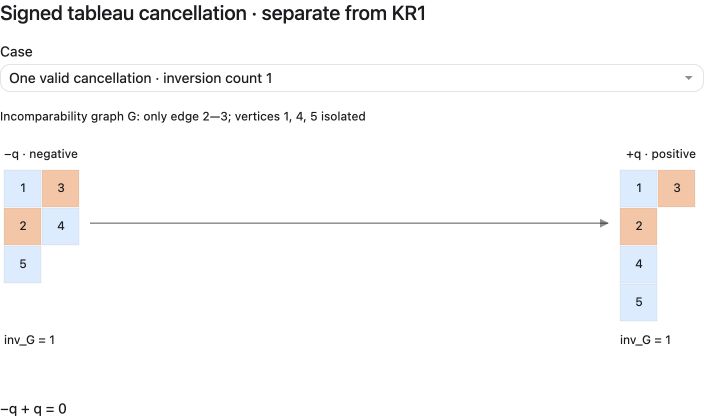
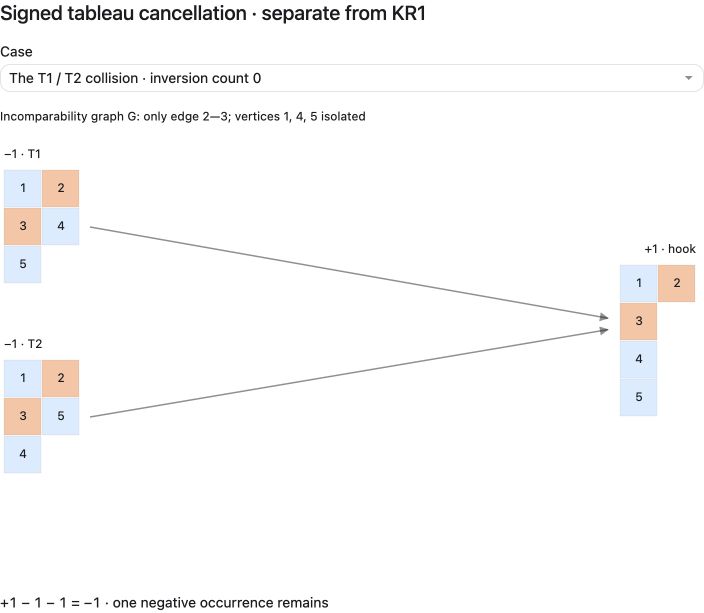
Switch between the valid cancellation and the collision
The primary KR1 task remains a reversible, weight-preserving translation between all original residue and gap partitions. Repairing this separate tableau slide alone would not supply that translation.
2D and 3D: remember which numbered square moved
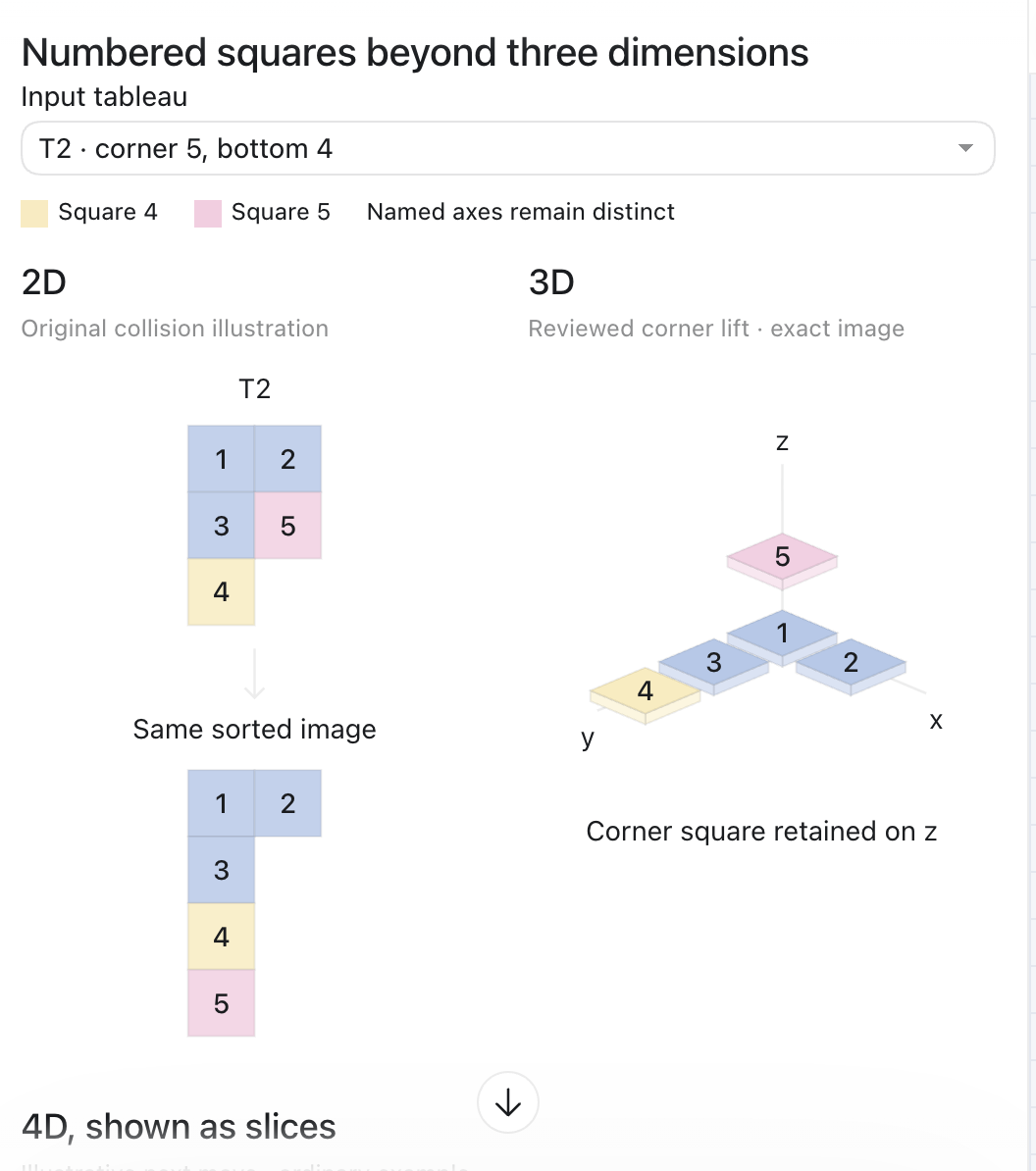
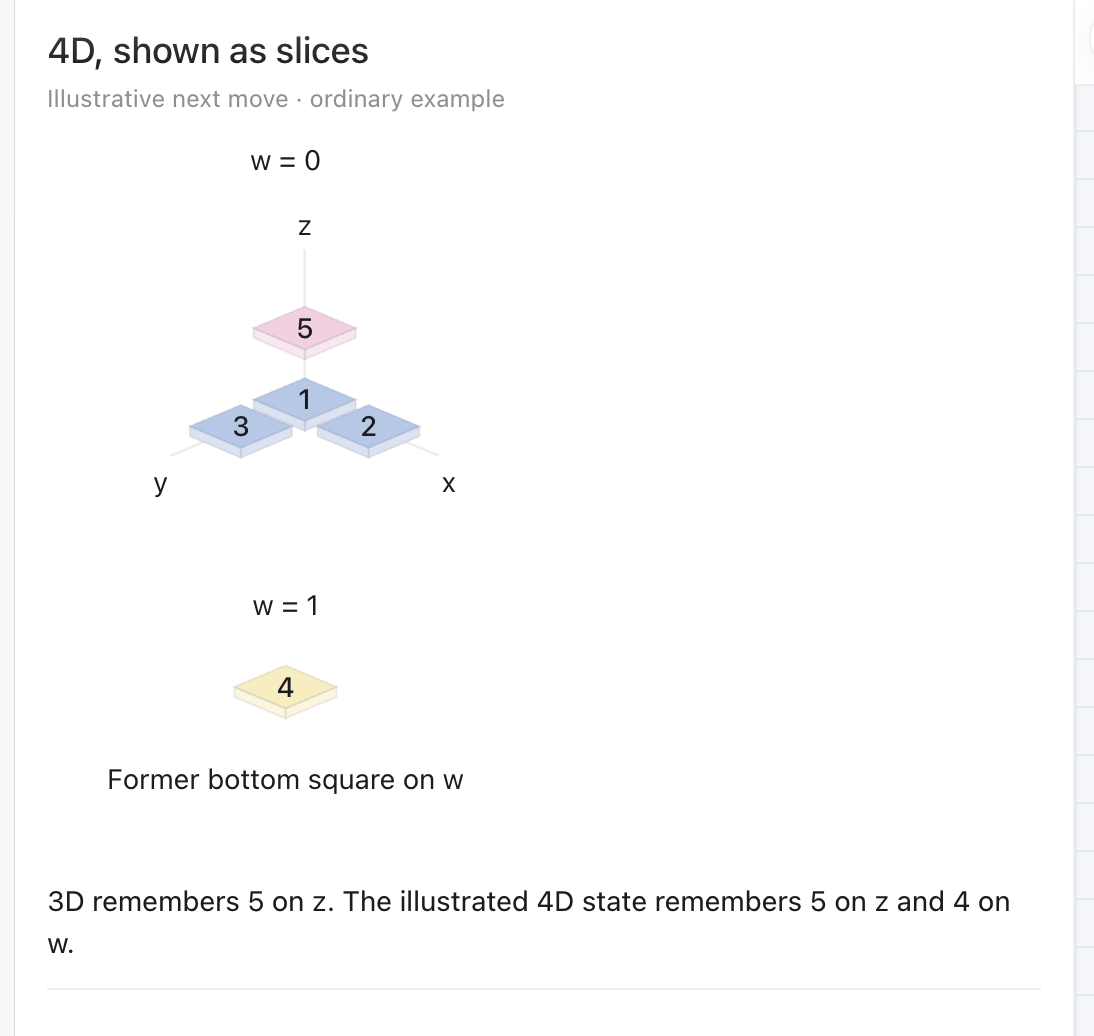
The 3D corner lift is a reviewed restricted construction. The 4D move is an illustrative extension, not a general KR1 target map.
Let the arrangement retain each selection
“Each step is an assignment of a tableaux square and number and you can extend each step into a new dimension.”
Place the actual numbered squares in a discrete multidimensional configuration. Each step may introduce another named axis. Record the selected move, recover it from the endpoint, and compare working and failing families for a uniform pattern.
Different finite inputs may use different finite dimensions. We seek existence of one suitable procedure; neither a unique procedure nor an optimal dimension is required.
Scope correction: the latest KR1 attempt mainly explored column counts and carries. It did not implement this full per-square procedure. The reviewed 3D lift is a restricted case; the final-target height condition is not a cap on intermediate dimension.
A fresh axis for each assignment
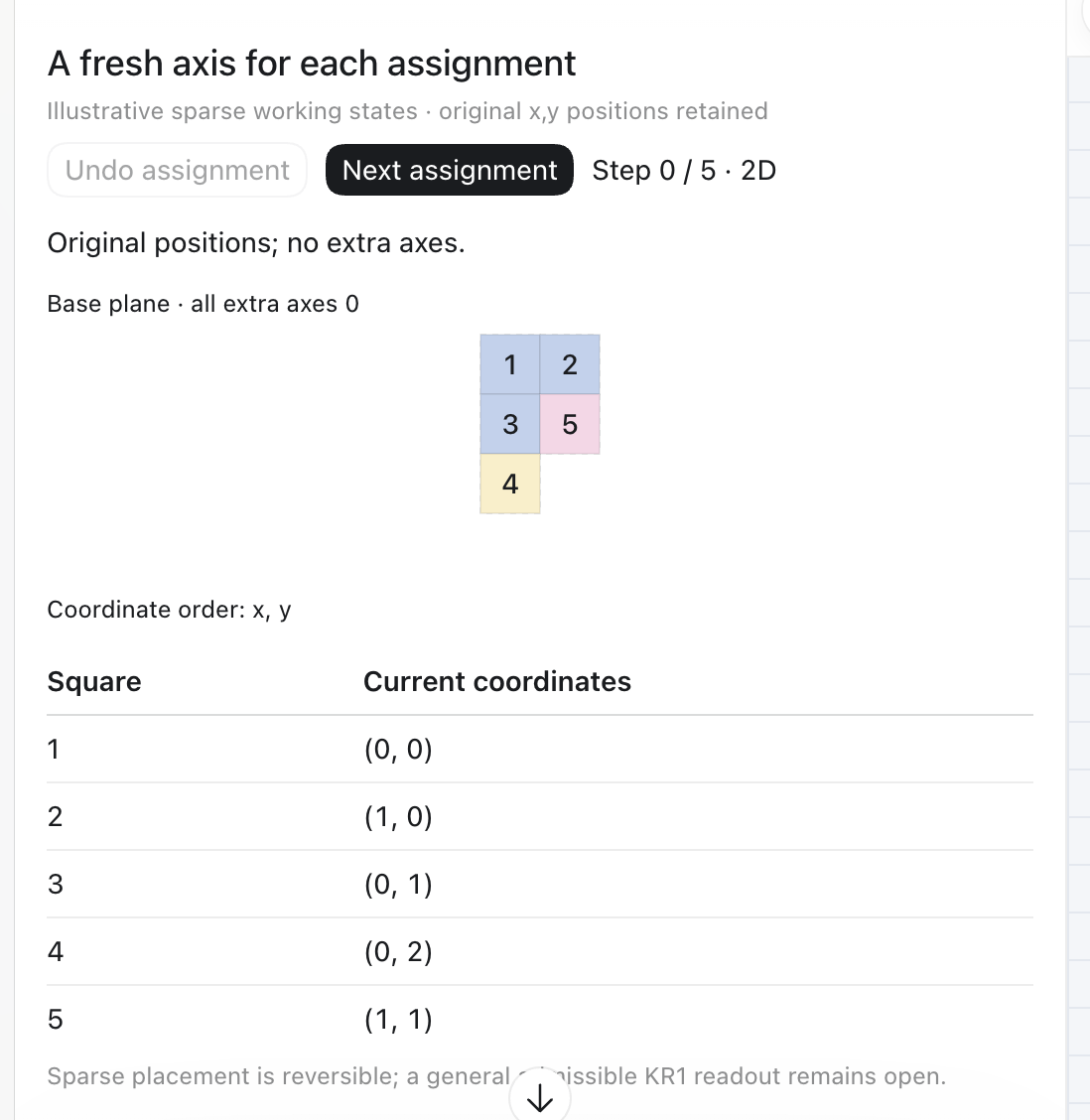
Try T1 / T2 and the reversible placement steps
Switch T1 and T2 to follow the swapped 4 and 5. Use Next assignment and Undo assignment to inspect the coordinate record.
What this example establishes: a recoverable placement mechanism on the illustrated configurations. The 4D move and the lower stepper are separate illustrative conventions. The stepper allows sparse states, so it is not a proof of Ferrers admissibility or of all required statistics in general.
The bridge the algorithm still needs
The second correspondence need not be literal geometric flattening. It must preserve the required weight, distinguish inputs both within and across fibers, cover exactly the required target family, and let the final object determine every reverse choice. Simply forgetting the extra coordinates may restore the collision.
We must also decide which intermediate states are allowed. A genuine finite Ferrers down-set has cell-budget restrictions on active axes; a sparse working arrangement is a different intermediate object. The target translation must account for that choice.
A concrete KR1 test: memory and the bottom boundary
The accepted carries retain a recognizable exchange count and small columns that keep the terminal boundary valid. The failed exchange preserves weight but breaks that boundary. This is a test for any proposed decoder from the extra-dimensional arrangements.
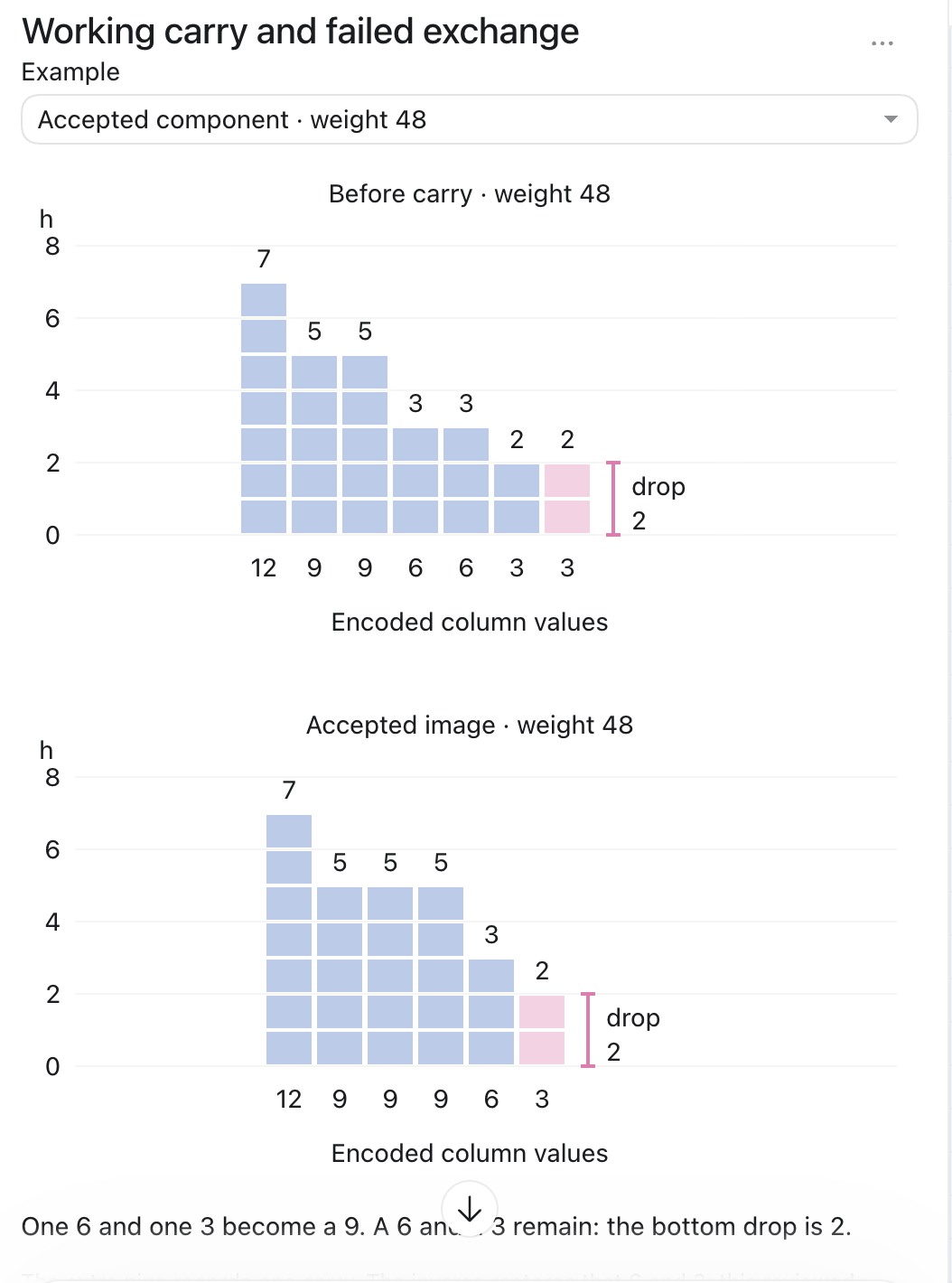
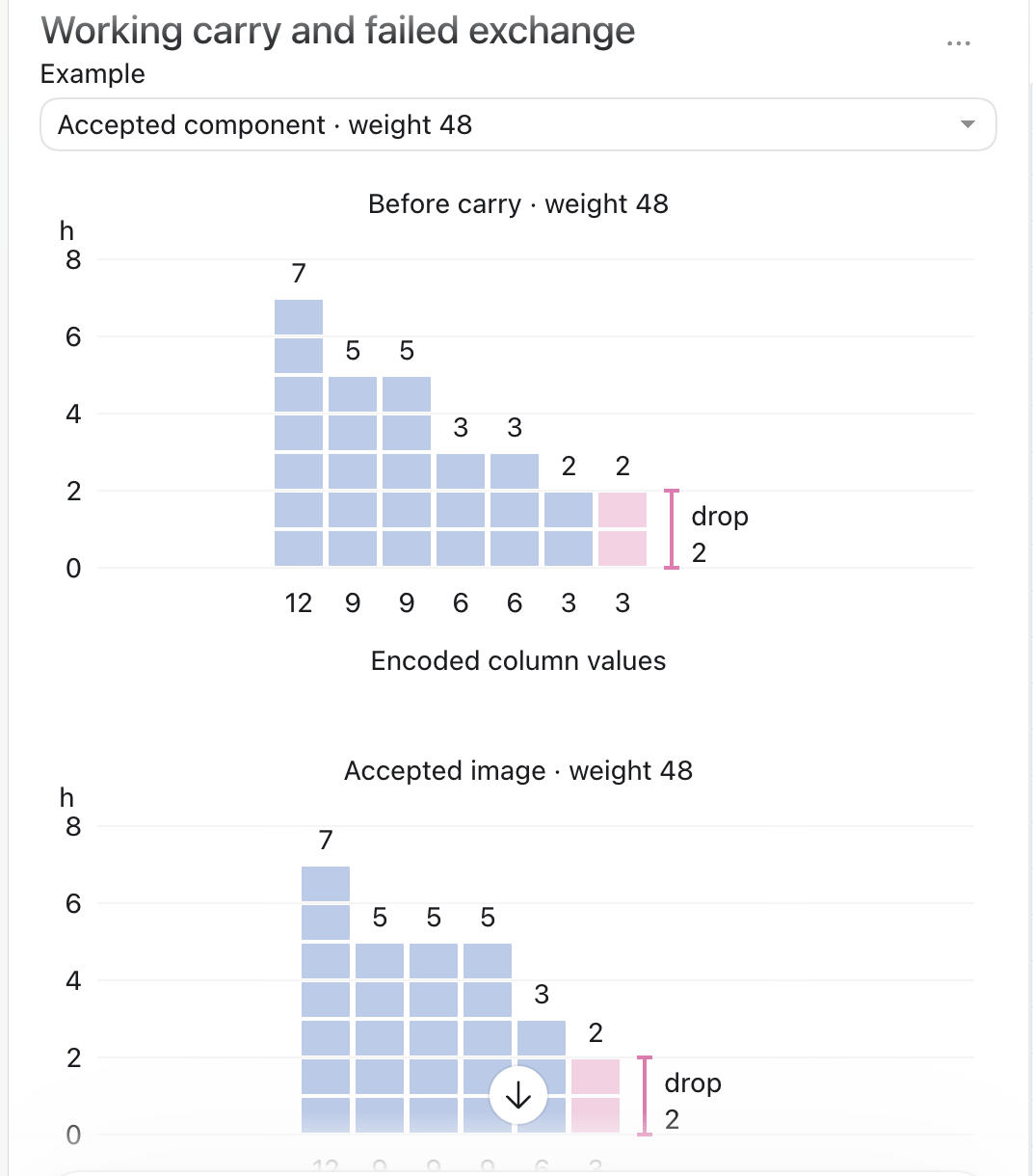
Compare the working carry with the failed exchange
Record the puzzle, then state the rule
- Placement memory: a named coordinate can retain which numbered square moved; the endpoint must reveal how to undo it.
- Recognizable branches: the reviewed partial families use visible marker patterns and carry counts to select an inverse.
- Boundary validity: an equal-weight exchange can still violate the original target's rules.
- Global separation: separating one fiber is not enough if another fiber or retained source uses the same final target.
The next proposal should specify literal placements, intermediate admissibility, invariant, selected endpoint language and a target-only decoder before checking. Use the remaining h000 core case from iteration 02 as the first KR1 readout testbed.
Record each step with a full timestamp, label, old/new coordinates, introduced axes, selected permutation, invariant, inverse guard and first failure. The external log helps find patterns; the final inverse must not depend on a missing diary.
Current status: this is a proposed general approach with reviewed restricted ingredients and illustrative traces. The full KR1 bijection remains unresolved. This regroup has not launched another research run.