What can grow, what is proved, and the next global construction
The full structural KR1 bijection remains unresolved. We now have a universal obstruction to fixed column support, a conditional way to preserve accepted assignments, and positive auxiliary models at every level. The missing branch maps are stated precisely.
An actual accepted weight-24 example
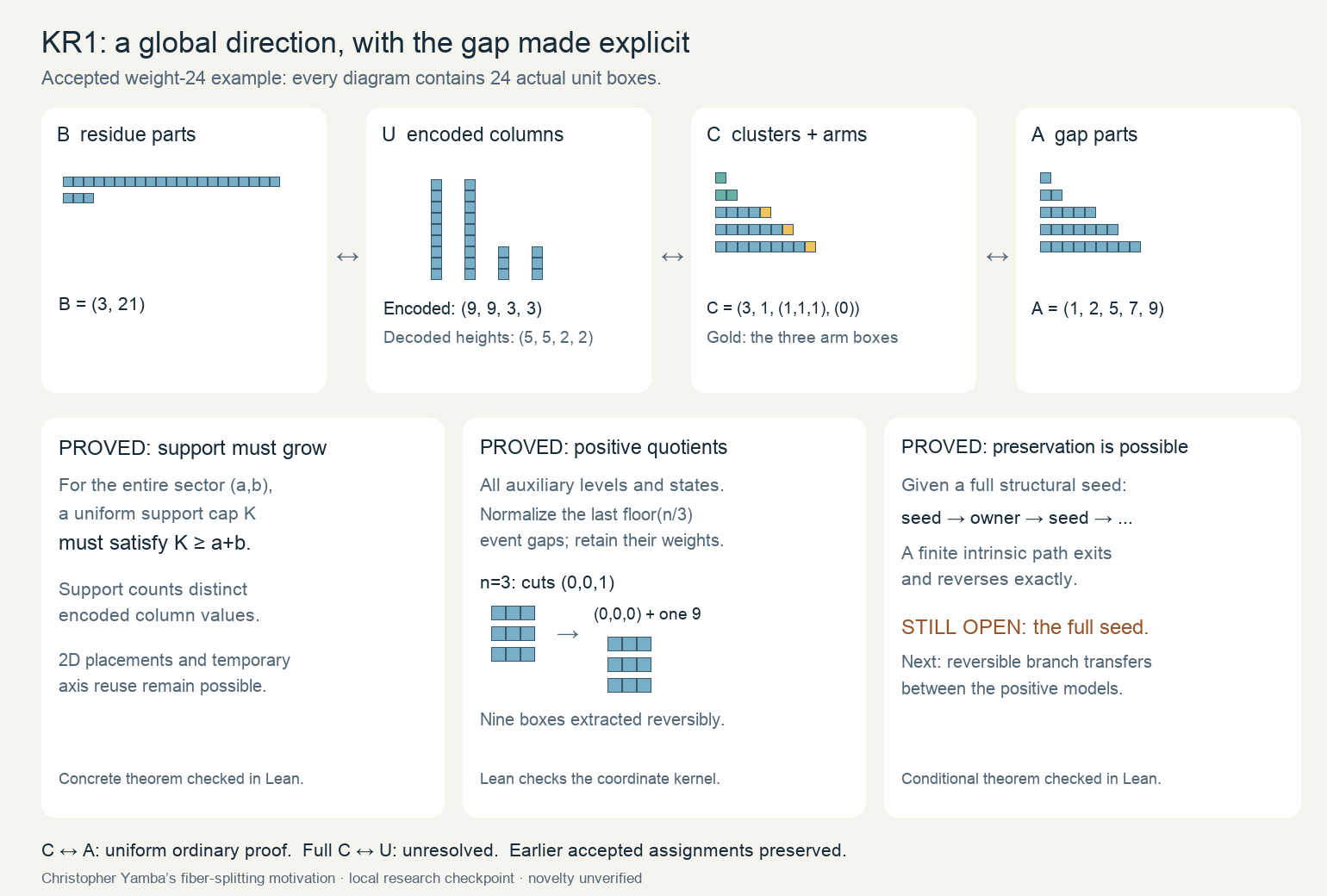
B=(3,21) ↔ U=(9,9,3,3)
↔ C=(3,1,(1,1,1),(0)) ↔ A=(1,2,5,7,9).
This is an accepted example checked in both endpoint directions. It does not establish a full bijection.
Three results that change the next search
- Support obstruction: proved, with an actual-column Lean certificate. An injective weight-preserving map of a complete sector (a,b) cannot have a uniform cap K on distinct final column values unless K≥a+b. This bounds final support; it does not bound spatial dimensions or refute variable-support 2D placements.
- Accepted preservation: proved conditionally, with a generic Lean certificate. Given a total structural seed, finite alternating owner paths preserve every old assignment. The required full seed has not been constructed.
- Positive auxiliary models: separately reviewed ordinary proof. Terminal-gap normalization gives reversible positive quotients at every level. Lean certifies the gap/level kernel; the complete colored family adapter is not fully formalized.
A separate uniform C↔A endpoint has an ordinary proof and distinct review. It addresses an endpoint, rather than supplying the missing C↔U bridge.
The next construction: two reversible branch maps
Let z=3n+3. On the positive auxiliary normal forms, construct:
Fᶜₙ ↔ Fᴬₙ₊₁ ⊔ (z + Fᴮₙ₊₁) ⊔ (2z + Fᶜₙ₊₁)
Fᴬₙ ⊔ ((9n+7) + Fᶜₙ₊₁) ↔ {empty or literal 3n+1} × Fᴮₙ
Start at n=2→3, where the first extra normalization factor appears. Each branch needs intrinsic recognition, literal inverse moves, weight and validity, exact image, both inverse identities and termination. Zero corrected terminal gaps need not mean equal literal levels.
Equal generating functions do not choose these branches. Neither transfer is currently constructed. Closing them uniformly would advance the full structural proof; the resulting concrete composition and endpoints would still need formal certification.
Give Claude the evidence as well as the article
A fresh Claude Code worktree is a useful next independent challenge. Begin with a skeptical audit, then target the first transfer. Use a new bounded contract and leave prior worktrees and frozen records untouched.
Read the complete article · Download proofs, code, Lean, reviews and Claude handoff
Regroup records
One regroup, one next approach, one recorded outcome
- Visual regroupCodex explains what works, what collides and what remains open.
- Christopher's intuitionContemplate the diagrams; propose a move, memory or new direction.
- Concrete handoffRecord the idea, invariant, first falsifier and a bounded task.
- Separate research worktreeClaude Code or Codex develops the construction without sharing an active checkout.
- Results and criticismSave proofs, checks, first failures, uncertainty and reviewer findings.
- Next visual regroupBring the output back, update the picture and choose the next idea.
↺ Repeat as the next numbered iteration. A failed candidate becomes evidence for the next discussion.