What survived, and why the joint map failed
Christopher asked to regroup before another Claude Code handoff. We combined Claude's evidence with the bounded Codex attempt and separated useful infinite partial constructions from two failed whole-sector packages.
The complete (3,1) core sector
C=(3,1,(x,x+y,x+y+z),(v))
x,y,z,v ≥ 0 · weight = 21+3x+2y+z+3v
Completing this sector would be a partial result toward full KR1. The run did not complete it.
Retained
The reviewed baseline, the corrected x=y=0 boundary plane and Claude's G6 family with its safe funding threshold.
Added
Eight infinite component families with ordinary arguments and a distinct critic's review, conditional on the retained baseline.
Discovery checks through weight 46 covered 7,617 accepted sources, preserving all 7,022 retained assignments and adding 595. Within the (3,1) sector, 721 sources were covered and 1,129 remained outside the accepted domain. These finite counts are not a universal proof.
The carry must retain a valid bottom boundary
The accepted carry exchanges equal weights while leaving recognizable small columns. The number of extra nines records the carry count. The rejected package preserved the total weight but produced a target with an invalid terminal drop.
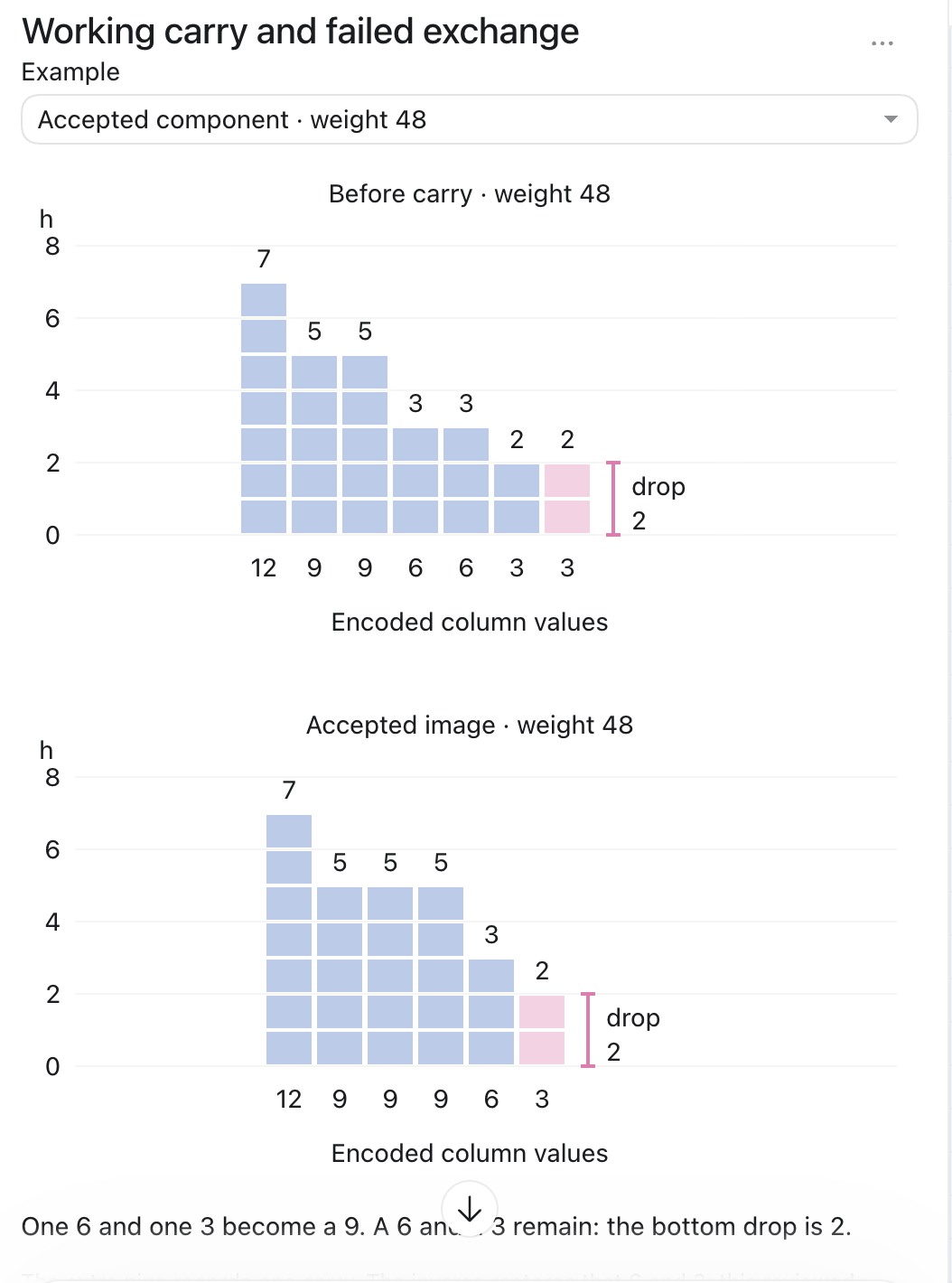
Open the interactive diagram on its own ↗
Refuted target: (9,9,9) → decoded heights (5,5,5) → final drop 5 > 4
“Height” here means the height decoded from a weighted KR1 column. It does not limit the dimension of an intermediate construction.
Keep the failures and narrow their conclusions
- The first joint package failed at weight25: a proposed target was already hit by an omitted source branch.
- The one permitted structural repair failed at weight 27: its exchange landed outside the admissible target family.
- K-1 excludes the specified single global affine-rule ansatz. The failed hanging lift excludes its placement and convention. Neither excludes all higher-dimensional constructions.
A reversible ping-pong walk can preserve retained final assignments only after we supply a suitable joint injection. The walk does not manufacture that missing injection.
Expose the remaining source language and its target decoder
The first uncovered core source is C=(3,1,(1,1,1),(0)), weight24, with auxiliary target (9,9,3,3). First determine whether that particular target has a retained owner; an uncovered source need not itself exhibit a collision.
Christopher then clarified that the proposed procedure should allow a new coordinate at every numbered-square assignment. That broader literal placement model is the focus of iteration 03, using this remaining core as a concrete KR1 testbed.
Assurance: reviewed conditional partial results; both whole-sector packages refuted; full KR1 and the complete core unresolved. No novelty claim or Lean certificate.